Clips AI
Python library that auto-splits long podcasts and interviews into clips and reframes them
Clips AI is an open-source AI tool for social media. It is available on API, CLI, Linux, macOS, Windows and Self-hosted.
- Pricing
- Open source
- Platforms
- API, CLI, Linux
- Listing updated
Similar tools
About Clips AI
The library works from the transcript rather than the raw frames. It transcribes a video with WhisperX, then scores segments of the transcript to pick out self-contained clips with start and end times you can use for trimming.
A separate resizing function reframes the picture to a different aspect ratio, such as 16:9 to 9:16, and follows whoever is currently speaking. Speaker detection relies on Pyannote, which requires a Hugging Face access token.
It is aimed at developers who want to batch-process audio-centric, narrative footage like podcasts, interviews, speeches and sermons inside their own pipelines. Installation requires Python, ffmpeg and libmagic alongside the pip packages.
What it does
- Transcript-based clip finding
- Locates candidate clips by analysing the video's transcript and returns their start and end times.
- Word-level transcription
- Uses WhisperX to transcribe audio with per-word timing information.
- Speaker-aware reframing
- Crops and reframes the video to keep the current speaker in view while changing aspect ratio.
- Aspect ratio conversion
- Converts footage between ratios such as 16:9 and 9:16 with a single function call.
- Open-source Python package
- Installable with pip and usable from Python code without a hosted service.
Good for
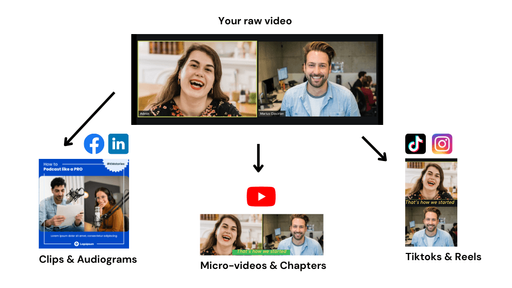
- Turning a long podcast episode into short vertical clips for social platforms
- Repurposing interview or speech recordings into shorter highlight segments
- Automating the reframing of landscape video into portrait format in a processing pipeline
Pricing
Open source
Open-source Python library; no paid plan mentioned.
Prices change. Check clipsai.com before you buy.
Clips AI FAQ
Is Clips AI open source?
The website describes it as an open-source Python library.
What kinds of videos is Clips AI designed for?
It is designed for audio-centric, narrative-based videos such as podcasts, interviews, speeches, and sermons.
Do I need a Hugging Face token?
Yes, a Hugging Face access token is required to resize a video because Pyannote is used for speaker diarization. The site says Pyannote itself is not charged.
Is Clips AI free?
Yes. Clips AI is open source, so you can use and self-host it for free.
What are the best alternatives to Clips AI?
The closest alternatives to Clips AI are Clip FM, Vidyo.ai, Opus Clip, Exemplary ai and Klap.
Where this comes from
- Description: written from the project's website.